
Geothermal well drilling in Dallas–Fort Worth
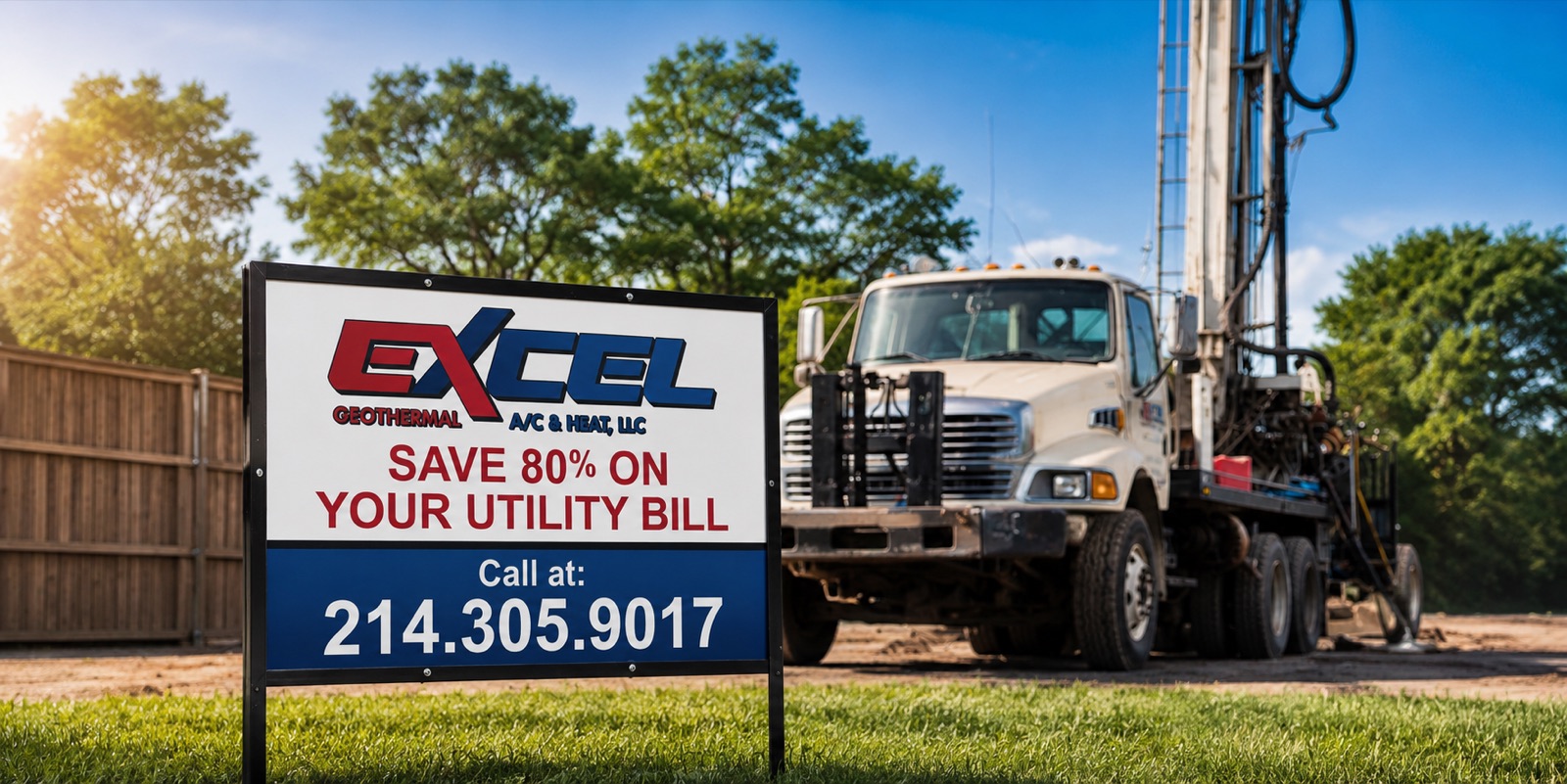
The ground loop decides whether your system saves 80% or falls short. That's why we own our drilling rigs and drill every well ourselves — no subcontractors, ever.
Texas Drillers License #59525C · TACL #23243E · Fully insured and bonded
What's under your yard, and why it matters
Every bore in North Texas starts in Blackland clay — the same sticky black soil that moves foundations when it rains. Below it sit shale and Austin Chalk limestone, which drill cleanly and move heat beautifully.
Think of the well like a cave. Below about 25 feet, the earth holds a steady 67–69°F all year — while Dallas air swings from 20°F to 105°F. Your loop simply borrows that steadiness.
We drill in this ground every week, from Highland Park to Celina, and keep drilling logs for the whole metroplex. Most addresses hold no surprises for us before the rig even arrives.
67–69°F year-round below ~25 ft — free and permanentOne-time infrastructure, not equipment
The wells are drilled once and designed to last 50+ years. Heat pumps get replaced every 20–25 years — the loop field keeps working for the next one.
How we drill a geothermal well
Survey and layout
We map bore locations 15–20 feet apart and locate every utility, sprinkler line, and septic system first. You'll know exactly where drilling happens.
Rig setup
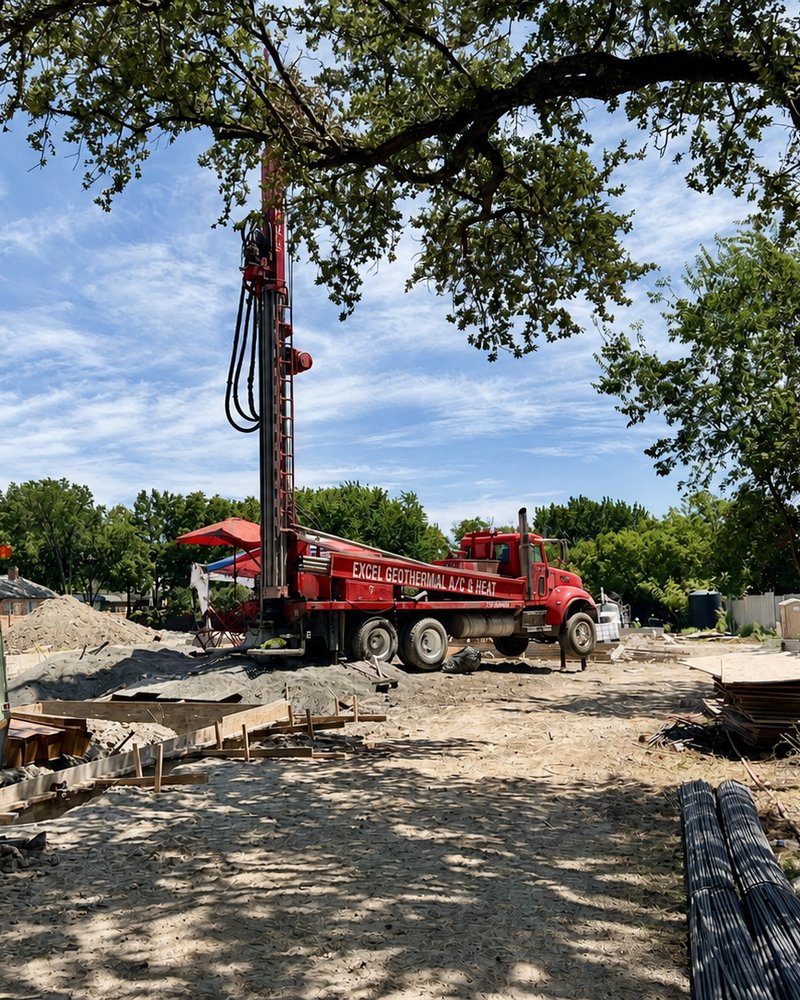
Our compact truck-mounted rigs fit through a standard backyard gate and work around pools, fences, and landscaping.
Drilling
The bit advances 150–400 feet through clay, shale, and limestone while water carries cuttings up and steadies the hole.
Loop insertion
A U-bend of HDPE pipe goes to the bottom of the bore — one continuous closed loop with no fittings underground.
Grouting
Thermally enhanced grout fills the bore from the bottom up. It presses the pipe against the earth for heat transfer and seals the well to protect groundwater — a Texas state requirement.
Header piping
Shallow trenches connect every well to the house with heat-fused joints as strong as the pipe itself.
Pressure test, then backfill
Nothing gets buried until the whole loop field holds pressure. If a loop won't hold, we fix it while the ground is still open.
Vertical wells or horizontal trenches?
Both work. The right one depends on how much yard you have. Most DFW lots choose vertical — it needs about as much space as a parked car per bore.
Takeaway: vertical goes deep on a small footprint — the choice for most DFW lots. Horizontal goes wide and shallow, and needs roughly a quarter acre of open ground.
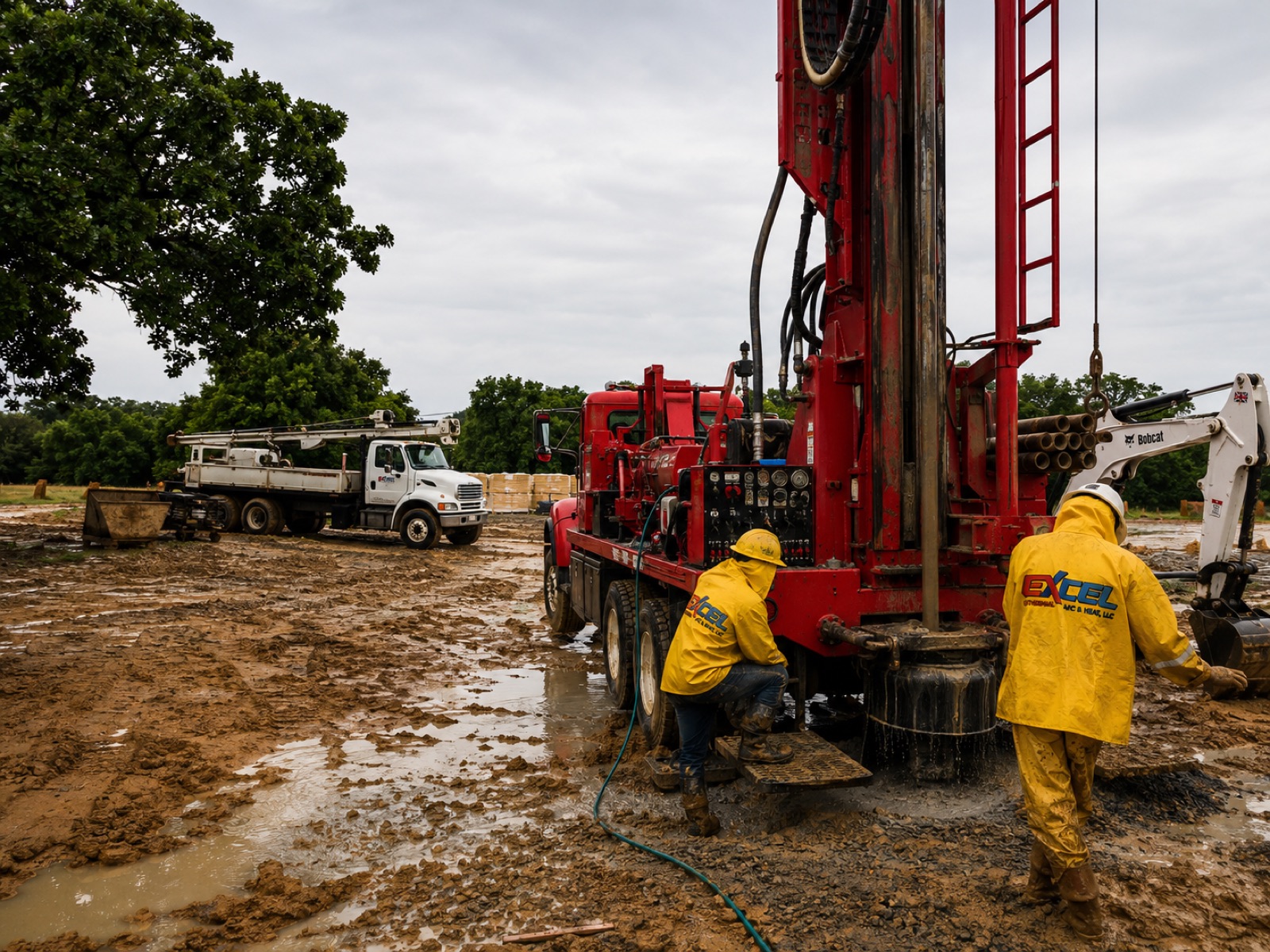
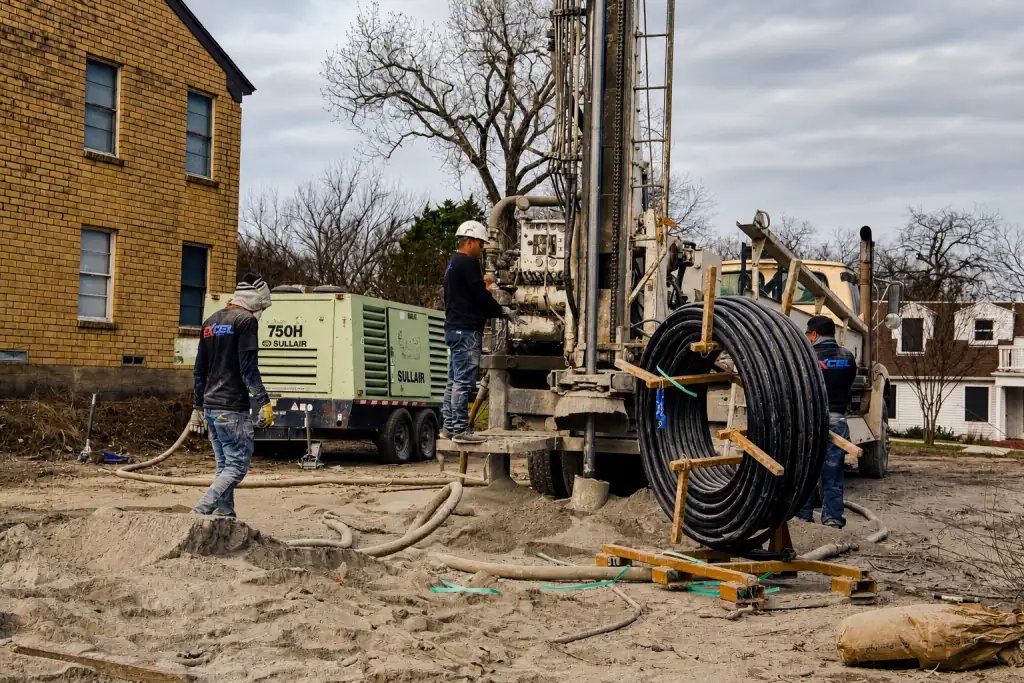
Vertical bores tuck into a corner of the yard. A 4-ton home usually needs 4–5 wells — after one growing season you won't be able to find them.
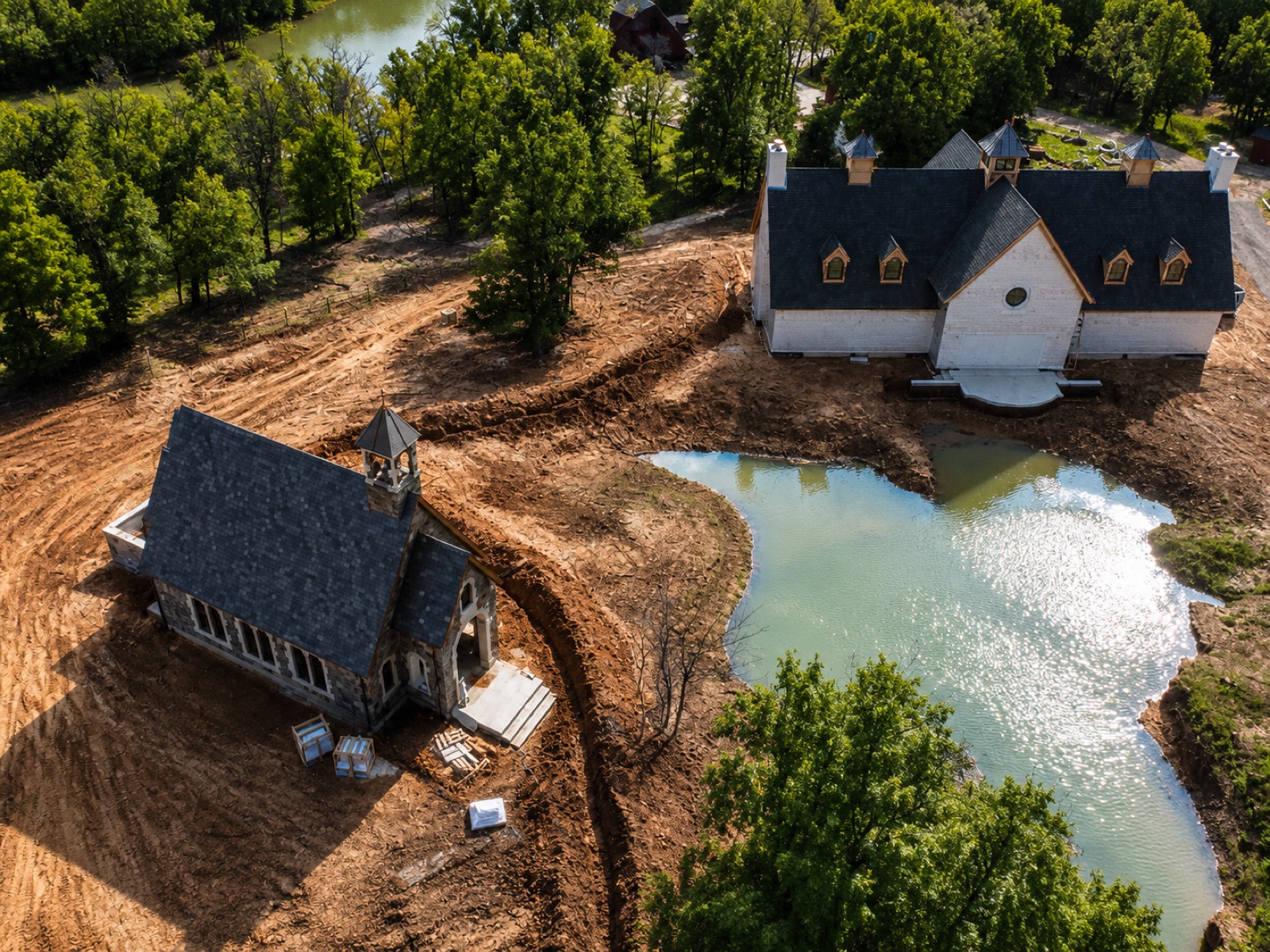
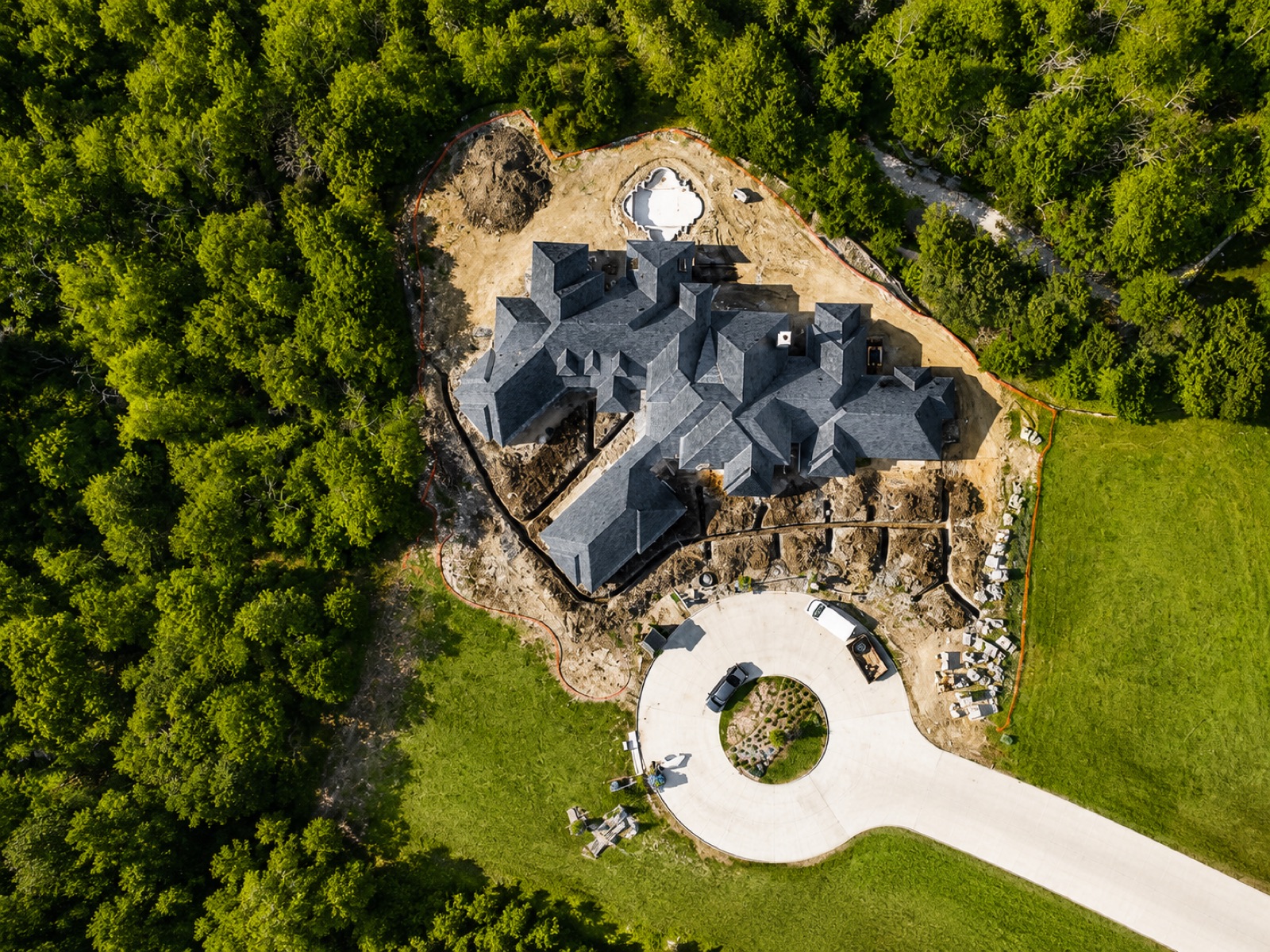
On acreage in places like Lucas, Prosper, or Celina, wide 6–10 ft trenches can cost less to install than drilling — if you have about a quarter acre to spare.
One company owns the whole hole
Most HVAC companies hire out drilling. We never have — and it shows in the part of your system nobody can inspect after the ground closes up.
Our rigs, our crew
Two company-owned rigs and drillers on our payroll. No per-bore subcontractor racing to the next job.
Licensed and sealed
Texas Drillers License #59525C. Every well is grouted bottom-up to state standards to protect the aquifer.
One schedule
Drilling and installation run on the same calendar, so your project never waits on someone else's driller.
Pressure-tested proof
Every loop holds test pressure before backfill. If it can't, we fix it — no finger-pointing between trades.
Drilling myths, corrected
Myth: "Drilling will wreck my foundation."
Fact: a bore is 5–6 inches wide, placed a safe distance from the slab during the survey, and grouted solid. It's the Blackland clay swelling after rain that moves DFW foundations — not a sealed well.
Myth: "The pipes will wear out and I'll have to dig it all up."
Fact: HDPE pipe doesn't rust or rot in soil and its joints are heat-fused, not screwed. The loop field is designed to last 50+ years — it will outlive at least two heat pumps.
Myth: "You hit water and it's a disaster."
Fact: groundwater actually helps by carrying heat to your loop faster. Texas licensing exists so wells near aquifers are sealed correctly — which is exactly what our license covers.
Driller words, plain English
- Bore
- The hole itself — 5–6 inches wide, 150–400 feet deep. Roughly one per ton of system size.
- U-bend loop
- One pipe down, a factory-welded turn at the bottom, one pipe back up. Water circulates through it forever; nothing is consumed.
- Grout
- A heat-conducting seal pumped in from the bottom up. It hugs the pipe against the earth and keeps water layers underground from mixing.
- Header
- The shallow piping that gathers all the wells together and carries the water to your heat pump.
What this means for your bill
ERCOT electric rates keep drifting up, but the earth's 67°F never sends an invoice. Once the wells are in, every future heat pump you own gets its "fuel" from your backyard at no cost.
Geothermal drilling questions, answered
Most residential bores are 200 to 300 feet. Commercial bores can reach 400 feet. Depth depends on system size, your lot, and the rock under your property — we confirm it during design.
Roughly one bore per ton of capacity. A typical 4-ton home needs four to five wells, spaced 15–20 feet apart so they don't steal heat from each other.
No. Wells are located a safe distance from foundations, pools, and utilities during the site survey, and each bore is grouted solid so the surrounding soil isn't disturbed.
Expect temporary mess in the work area — we contain the cuttings and regrade when finished. Yards recover within one growing season, and then the wells are invisible.
Two to four days for a typical residential field of four to six wells. Large commercial fields — like the 55 wells we drilled at Home Run Alley in Lucas — take several weeks.
Yes — Texas requires a licensed well driller and proper grouting to protect groundwater. We hold Drillers License #59525C and handle every permit and state report for you.
Related services
Geothermal Installation
The full system — wells, heat pump, ductwork, and commissioning, all from one crew.
Learn moreCommercial Geothermal
Schools, churches, and facilities — including our 55-well flagship in Lucas, TX.
Learn moreHeat Pump Replacement
Already have wells? They'll outlast the equipment — replace just the heat pump.
Learn more